
Getting admission into a Nigerian university is a huge win but life doesn’t always follow plan. Maybe you need time for medical treatment, a scholarship interview abroad, compulsory service, family reasons, or to sort finances and housing. If that’s you, deferring (postponing) your admission for one year can be the best move it protects your place while you fix what needs fixing.
This article gives a complete, practical, step-by-step guide on how to request and secure a one-year deferral from Nigerian universities. It covers: when to apply, who to contact, required documents, sample deferral letter you can copy, how schools usually respond, timelines and what can go wrong. It also answers common questions like whether you’ll lose your JAMB admission, how fees and registration are affected, and how to re-activate your admission next academic year.
Table of Contents
What does “defer admission” mean?
To defer admission means you ask your university to delay your entry/start date by a period (commonly one academic year) while keeping your original offer of admission valid. If approved, you don’t join that intake, but the school reserves your place for the agreed period usually 1 year.
Important practical effect: you are not an active student during the deferment year, but you retain the right to return as a fresher (or in some cases to the same level) once the deferral period ends and you follow re-activation steps.
Who can defer admission? (Common valid reasons)
Most universities grant deferrals for reasonable, verifiable reasons. Typical valid reasons:
- Medical reasons (you or an immediate family member) supported by hospital/doctor reports.
- Financial hardship where you can prove inability to pay tuition this session.
- National service / scholarship commitments requiring presence elsewhere temporarily.
- Visa delays or forced postponement for an approved foreign scholarship/program.
- Compassionate reasons (death in immediate family, etc.).
- Mandatory obligations (court summons, custody matters, etc.).
- Educational reasons like finishing compulsory pre-university program (rare normally you’d not be offered admission before completing).
Universities are less likely to accept purely convenience reasons (e.g., “I want to party”)always provide evidence where possible.
-

JAMB Flags Thousands of Illegal Admissions Nationwide — Board Clamps Down on Unauthorized Offers Across Institutions
The Joint Admissions and Matriculation Board (JAMB) has intensified efforts to crack down on illegal admissions across Nigeria’s tertiary institutions. In a recent nationwide audit, the board flagged thousands of unauthorized admission cases, including candidates who were admitted without proper documentation or through unofficial channels. This move comes as part of JAMB’s broader mandate to…
-

No UTME/DE Form Fee Increase for 2026 Registration — JAMB Assures Applicants of Stable Registration Cost
The Joint Admissions and Matriculation Board (JAMB) has officially confirmed that there will be no increase in the registration fees for the 2026 UTME (Unified Tertiary Matriculation Examination) and Direct Entry (DE) forms. This announcement comes as a relief to millions of Nigerian students and their parents who annually prepare financially to participate in these…
-

Affordable Universities Candidates Should Consider for 2026 UTME — List of Accessible Universities for UTME Aspirants
Every year, thousands of Nigerian students sit for the Unified Tertiary Matriculation Examination (UTME) with hopes of securing admission into top universities. While some candidates dream of elite federal or private universities, the reality is that tuition and living costs can be prohibitively high for many families. For these students, choosing affordable universities becomes a…
When should you apply? (Timing & deadlines)
- Apply immediately once you know you need to defer. Don’t wait until the week before matriculation.
- Many universities accept deferral requests before formal registration and matriculation. If you’ve already registered and matriculated, deferral is harder (may require withdrawal + fresh application).
- Deadlines vary by school some accept deferral until the start of the academic session; others close the window at matriculation. Apply during the offer phase (after you received admission) for best chance.
- Check the Registrar’s office and the school’s portal for exact dates for your university.
Step-by-step process (what to do, in order)
Follow this practical workflow, copy it exactly and adapt to your school:
Step 1. Read your offer & school site
Immediately read the admission offer and the university’s admission/matriculation pages. Some schools explicitly state deferral rules there.
Step 2. Prepare documents
Gather evidence (medical reports, sponsor letter, proof of scholarship, affidavit, etc.). See section 5 for a full checklist.
Step 3. Write and submit an official deferral request
Address to the Registrar (or Director of Admissions) via the university portal or as a written letter/email. Use the sample letter below.
Step 4. Pay any required administrative fee (if applicable)
A few universities charge a small fee to process deferrals. Confirm on the portal.
Step 5. Follow up
If you don’t hear back in 7–14 working days, call the Registrar or Student Affairs or visit personally (if possible). Keep copies of everything submitted.
Step 6. Get written confirmation
If granted, demand an official letter/email that states: deferral approved, length (one year), and any actions you must take (e.g., re-activate by date, pay acceptance fee again, documentation on return).
Step 7. Note conditions
Some schools require you to retake certain registrations, show updated documents on return, or pay fresh acceptance fee. Record these.
Step 8. Follow JAMB/CAPS (if applicable)
If your admission involved JAMB CAPS or state JAMB procedures that expect you to accept/acknowledge, confirm with your school whether you should accept the admission on CAPS or wait for the new intake. (Most schools will instruct you.)
Documents you will need (checklist + upload tips)
Prepare one neat PDF (or separate PDFs) with:
- Cover/Request letter addressed to the Registrar.
- Copy of admission letter / JAMB offer / school offer email.
- Valid ID (national ID, passport, or driver’s licence).
- Evidence of reason:
- Medical: hospital letter, doctor’s note, treatment schedule.
- Finances: bank statement, sponsor affidavit, proof of salary cut.
- Study/scholarship abroad: scholarship offer letter or visa rejection document.
- Compassionate: death certificate, court documents where applicable.
- Contact info: phone, email, home address.
- Any required fee payment receipt (if the university requests a processing fee).
- Signed undertaking if required by school (promise to return on the stated date).
Upload tips:
- Use PDF for all documents. Keep filenames clear (e.g.,
Deferral_Letter_Peter_2025.pdf). - Scan in black & white at 300dpi for small size.
- If using email, attach everything and put a short message in the body summarizing the request. Save the sent email receipt.
Sample deferral letter (copy & use)
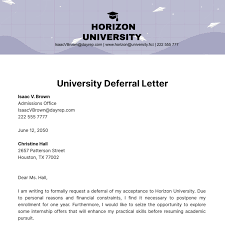
[Your Full Name]
[Your Address]
[Phone] • [Email]
Date: [DD Month YYYY]The Registrar,
[Full official university name],
[University Address / City]Subject: Request for One-Year Deferment of Admission (Academic Session [year])
Dear Sir / Ma,
I write to respectfully request a one-year deferment of my admission into the [Your Course e.g., B.Sc. Computer Science] programme for the [2025/2026] academic session. I was offered admission on [date of offer] (Admission Number / Application ID: [ID]).
The reason for this request is [state reason briefly e.g., medical treatment / scholarship abroad / financial hardship / family emergency]. Enclosed are supporting documents: [list attachments e.g., hospital report, scholarship letter, bank statement etc.].
I request that my admission be held and that I be permitted to join the next academic intake (2026/2027) with the same status and conditions as the current offer. I understand any conditions attached to this deferment and agree to comply with the university’s requirements on reactivation.
Please confirm receipt of this request and inform me of any further information or fees required. I would be grateful for an official written response.
Thank you for your understanding and assistance.
Yours faithfully,
[Your name & signature]
[JAMB Reg. No. / Admission Ref No.]
What happens after you submit a deferral request? (timeline)
- Acknowledgement: within a few days you should receive an acknowledgement email or portal notification.
- Review: Registrar/Admission office reviews 7–21 working days is typical. Complex cases (medical verification) may take longer.
- Decision: you will receive Written Approval or Rejection. Approval letter should state the deferral length (one year), any fees, and next steps.
- If approved: keep a copy of the approval and any reference number.
- If rejected: you usually have the option to appeal by supplying additional evidence or meeting the admissions officer.
Fees, acceptance fees & refunds, what to expect
- Acceptance fee: If you have not yet paid the school’s acceptance fee, deferral is usually simple — pay when you return.
- If you already paid: some universities allow transfer of paid fees to the next session; others may require re-payment. Get this in writing.
- Refunds: full refunds are rare once processing begins. If refund is essential (e.g., you paid but have financial hardship), ask the bursary and registrar provide strong evidence.
- Processing fees: a few schools charge a small administrative fee to process deferments — check the portal.
Always get fee policy in writing when a deferral is approved (so there’s no surprise when you return).
Common rejections and how to avoid them
Universities commonly reject deferrals when:
- The request is late (after matriculation/registration). → Avoid by applying early.
- The reason is not supported by evidence. → Provide strong, verifiable documents.
- The applicant already registered/matriculated. → If you already matriculated, speak to Student Affairs about temporary leave or withdrawal policy.
- The course/school has no deferral policy due to capacity issues. → If the school cites capacity, ask about guaranteed re-admission route (often they provide conditional offers for next year).
- The deferral is for indefinite/time-unspecified reasons. → Always request a fixed period (one year) and give a return date.
If rejected, appeal politely with added documents or request to speak with the admissions officer.
How to reactivate your admission next year
Do this before the new session starts:
- Contact Registrar: send an email referencing your deferral approval and state your intent to resume.
- Follow the school’s re-activation instructions sometimes you’ll need to:
- Confirm in writing;
- Pay any outstanding acceptance/registration fees;
- Present updated documents (e.g., new medical forms if applicable).
- Check the timetable: ensure you meet any pre-matric requirements (medicals, placement tests, orientation).
- Verify JAMB/CAPS status: if your admission uses JAMB CAPS, the school should advise if any action is required on CAPS.
- Get final confirmation: an official letter/email confirming your slot for the new intake and registration steps.
FAQs
Q1. Can I defer admission after I have registered?
A: It’s harder. If you’ve completed registration/matriculation, most universities treat requests as withdrawals and you may need to reapply. Speak directly with Student Affairs immediately.
Q2. Will my JAMB admission be lost if I defer?
A: No, if the university approves a deferral in writing they normally keep your admission. But always get the approval letter. Some JAMB/CAPS steps may require the school to update your status.
Q3. Can I transfer my acceptance fee to next year?
A: Depends on the school. Ask for this in the deferral response and get it in writing.
Q4. How long does approval take?
A: Usually 7–21 working days. Complex cases may take longer.
Q5. What if my deferral is denied?
A: You can appeal, supply more evidence, or consider withdrawing and reapplying next year.
Expert tips / Editor’s advice
- Apply early early requests are taken seriously and processed faster.
- Be professional write formally, attach documents, and keep records of everything.
- Get everything in writing verbal promises are not enough. Obtain a signed/emailed approval and keep it.
- Follow up politely if no reply after 10 working days, call the admission office and politely ask for status.
- Plan finances even with deferral you might be asked to re-pay fees later. Save/organize now.
- Use security copies store PDF copies on cloud and offline (USB). Universities often lose paperwork; you’ll be glad you kept backups.
Conclusion
Deferring admission for one year is a common, legitimate option for students who face genuine obstacles before starting university. The keys to success are: apply early, provide clear supporting evidence, submit a formal deferral letter, and get written approval with conditions. Follow the steps in this guide and keep copies of every communication you’ll maximize your chance of a clean, stress-free return next academic year.
-
JAMB Flags Thousands of Illegal Admissions Nationwide — Board Clamps Down on Unauthorized Offers Across Institutions
The Joint Admissions and Matriculation Board (JAMB) has intensified efforts to crack down on illegal admissions across Nigeria’s tertiary institutions. In a recent nationwide audit, the board flagged thousands of unauthorized admission cases, including candidates who were admitted without proper documentation or through unofficial channels. This move comes as part of JAMB’s broader mandate to…
-
No UTME/DE Form Fee Increase for 2026 Registration — JAMB Assures Applicants of Stable Registration Cost
The Joint Admissions and Matriculation Board (JAMB) has officially confirmed that there will be no increase in the registration fees for the 2026 UTME (Unified Tertiary Matriculation Examination) and Direct Entry (DE) forms. This announcement comes as a relief to millions of Nigerian students and their parents who annually prepare financially to participate in these…
-
Affordable Universities Candidates Should Consider for 2026 UTME — List of Accessible Universities for UTME Aspirants
Every year, thousands of Nigerian students sit for the Unified Tertiary Matriculation Examination (UTME) with hopes of securing admission into top universities. While some candidates dream of elite federal or private universities, the reality is that tuition and living costs can be prohibitively high for many families. For these students, choosing affordable universities becomes a…